
Oaks Forecast and Tricast Betting
 Available in US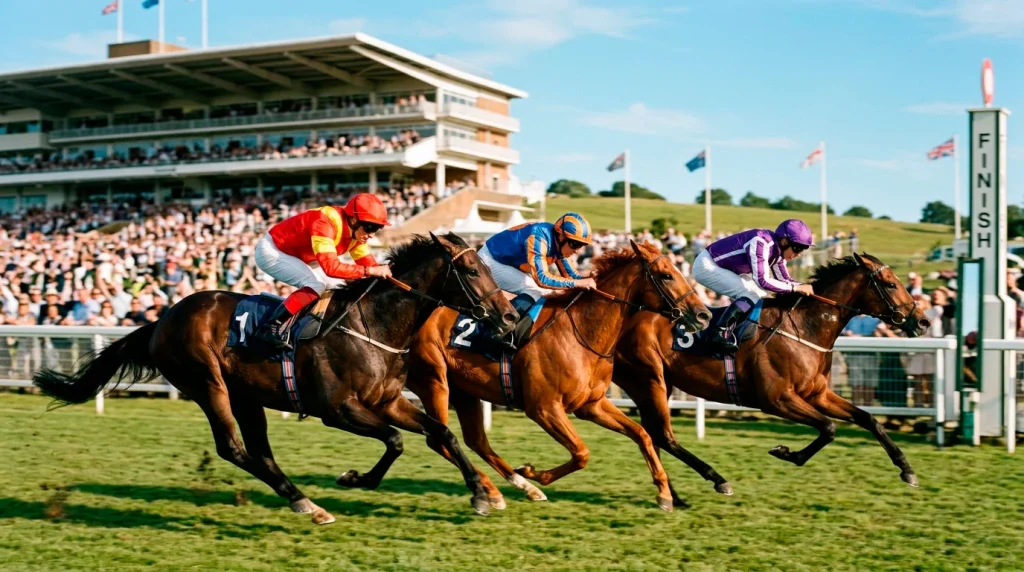
Beyond the Winner
Forecast and tricast bets ask you to predict not just the winner, but the finishing order. A straight forecast requires naming the first two home in exact sequence. A tricast demands the first three. The payouts reflect the difficulty: getting two or three runners right in precise order is far harder than picking a single winner, and returns can be dramatic when longshots fill out the places.
Field size determines feasibility. The BHA Racing Report 2026 notes that the average field size on the Flat in 2026 fell to 8.9 runners, down from 9.14 the previous year. For Premier fixtures like the Oaks, however, the figure is higher: 11.02 runners on average for Flat Premier races. A field of that depth creates genuine complexity in finishing order. Predicting the first two from eleven contenders involves dozens of possible combinations; predicting the first three multiplies those possibilities further.
The Oaks suits these exotic bets for a specific reason. The race often sees fillies separated by margins that reflect stamina reserves and course handling rather than raw ability. A nose, a neck, half a length — these finishing distances suggest that several runners were capable of placing. Form analysts who narrow the contenders to four or five serious prospects can use forecasts and tricasts to leverage that opinion more efficiently than a simple win bet.
Predicting the podium is a test of handicapping precision. The rewards, when you get it right, can justify the inherent difficulty.
Forecast Types Explained
A straight forecast is the purest form: you name the first and second in exact order. If you select Filly A to win and Filly B to finish second, only that specific result pays out. Should they reverse positions, you lose. Straight forecasts offer the highest returns for a two-horse prediction because the demand on accuracy is absolute.
Reverse forecasts cover both permutations. You back Filly A and Filly B to finish first and second in either order. This is effectively two bets in one, so your stake doubles. The returns are lower than a straight forecast that lands, but the probability of collecting increases. If you fancy two runners to dominate but cannot separate them, the reverse forecast makes sense.
Combination forecasts extend the logic. You select three or more runners and cover all possible pairings for the first two positions. With three selections, you have six permutations (three for first, two remaining for second). With four selections, you have twelve. Stakes multiply accordingly. Combination forecasts suit punters who have identified a strong shortlist but do not want to commit to exact sequencing. The cost rises quickly, but so does coverage.
Computer straight forecast (CSF) returns are determined by a formula applied after the race, based on the starting prices of the first two finishers. You do not know the exact return when you place the bet; it is calculated post-race. This differs from fixed-odds forecasts offered by some bookmakers, where the payout is quoted upfront. CSF returns tend to track market probability: if two outsiders fill the first two spots, the CSF dividend can be substantial. If two favourites dominate, expect modest returns.
Understanding which forecast type matches your view is critical. A straight forecast is a precision instrument. A combination forecast is a net. Choose according to your confidence level and bankroll tolerance.
Tricast Mechanics and Payouts
Tricasts require the first three finishers in exact order. The step up from a forecast is not incremental; it is exponential. Adding a third variable dramatically expands the universe of outcomes. In an eleven-runner field, there are 990 possible tricast combinations. Getting one of them right earns a payout; the other 989 do not.
Straight tricasts demand precision. You name first, second, and third in order. If your selections finish in any other sequence, you lose. The returns can be eye-watering: a tricast involving three double-digit-priced runners might return several hundred times your stake. The Oaks, with its competitive middle tier, occasionally produces such results. A quick glance at historical dividends confirms that long-priced tricasts are not fantasy; they happen when form holds and the market underestimates depth in the field.
Combination tricasts cover all permutations within your selection pool. Pick four runners, and you cover 24 different finishing sequences (4 × 3 × 2). Pick five, and you cover 60. The maths is relentless: stakes compound rapidly as selections increase. This approach suits punters who have isolated a tight group but accept they cannot rank them precisely. You pay for breadth with higher outlay, but you increase the likelihood of landing any tricast.
Computer tricast returns, like CSF, are calculated after the race based on starting prices. Unlike fixed-odds tricasts, you do not know the exact payout beforehand. The formula rewards unlikely outcomes. If the market favourite trails home fourth and three mid-range fillies fill the frame, the tricast dividend will reflect that surprise. This is where tricast bettors hunt: scenarios the market did not anticipate but which form study suggested were plausible.
Patience and selectivity matter. Tricasts are not bets for every race. In the Oaks, where field quality is strong and separations are often slight, the bet type finds fertile ground.
Strategic Use in Classic Races
Classic races attract strong fields where several runners have legitimate claims to hit the frame. The Oaks is no exception. Form from the trials often identifies a cluster of four or five fillies who have demonstrated stamina for the trip and class for the level. Within that cluster, margins can be tight. A tricast lets you capitalise on that analysis without the pressure of naming a single winner.
Consider the race shape. If you expect a contested pace with front-runners burning each other out, hold-up types may sweep the places. Identifying those closers and building a forecast or tricast around them gives you an angle the market may not fully price. Similarly, if the draw bias data suggests low-stall runners face a disadvantage, you can weight your exotic bets toward middle and high draws.
Staking matters. Combination forecasts and tricasts multiply quickly, so discipline is essential. Many punters set a total budget for exotic bets and work backwards to determine affordable coverage. A £1 combination tricast covering four runners costs £24; covering five costs £60. Decide your ceiling before filling out the slip.
Finally, integrate exotics with other bet types. A balanced approach might pair a win bet on your top fancy with a combination tricast covering her alongside two or three each-way contenders. You protect your downside while opening the door to windfall returns if the lesser lights over-deliver. Forecasts and tricasts are not replacements for traditional bets; they are complements, best deployed when your analysis points to multiple live runners without clear separation.
Responsible Gambling
Exotic bets carry elevated risk because they require multiple correct predictions. Combination stakes multiply quickly, and the allure of large payouts can encourage over-commitment. Set strict limits on what you wager on forecasts and tricasts, treating them as a small fraction of your total betting budget. If you find yourself chasing losses with ever-wider combinations, pause. Support services like BeGambleAware are available to help you maintain a healthy relationship with gambling.
Oaks Forecast and Tricast Betting — More on this topic at epsom oaks betting.
See also Best Bookmakers for Epsom Oaks.
